
We’ve reached chapter X.
Over our first 10 years, we’ve grown to 10 locations. Every office and every encounter has taught us something – and now we want to share the 10 most important lessons with you.
X Years
Fenno was born out of everyday reality and a need to do law differently. In ten years, we’ve grown into a close-knit network of people who understand local realities yet still dare to see the bigger picture.
Right from the start, we crossed out legal jargon and decided to leave our own mark on the industry.

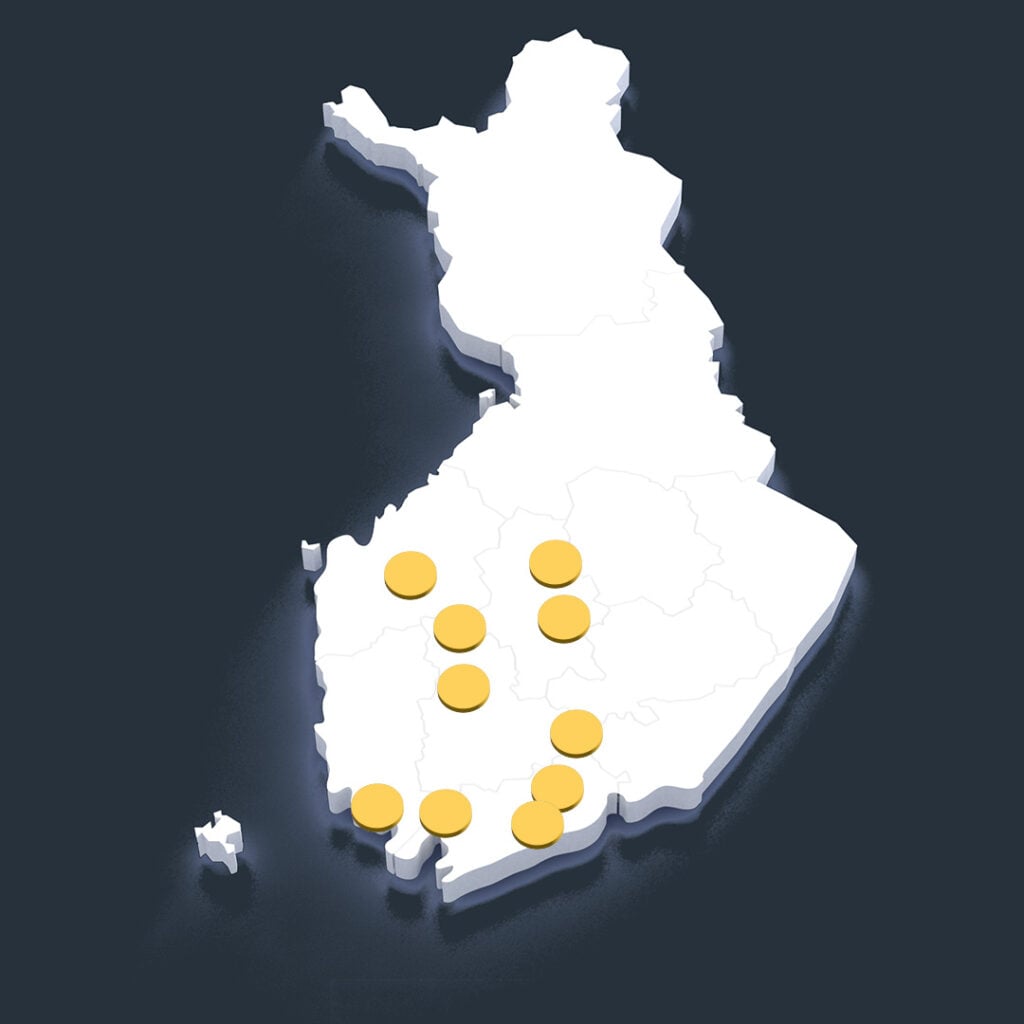
X Locations
Fenno means local expertise across ten offices, ten crossroads all around Finland.
Growth has given us nationwide strength, but we still want to stay close. Every office and every person has left their own mark on us.
X Lessons
A decade has taught us an enormous amount. That’s why, to mark our anniversary year, we want to share 10 lessons — in the words of the people of Fenno — that will continue to guide what we do in the future.
I Lesson
People drive growth
Sami Saarilampi
“A company’s growth isn’t measured only in revenue or number of assignments – the growth story of its people and workplace culture matters just as much. The best results come when you dare to trust and commit to your people from the very start. At Fenno, people who started out as students have grown into top experts, and some have even become partners or our CEO. When you make room for fresh, open-minded perspectives, you avoid blindly repeating old patterns.”
II Lesson
Team is an asset
Sini Nuoranne
“No one has the time to manage or know everything. Complex expert work requires the backing of a diverse group of people capable of viewing matters from various perspectives. Team support alleviates the workload, as one can always seek advice, share challenges, and solve problems together. At Fenno, success is a collaborative effort in which everyone plays a vital role; that is why the entire team deserves recognition. When even difficult tasks are handled together—systematically and meticulously—the result is always a more satisfied client and a more motivated team.”
III Lesson
Matters are strict, people are not
Emmi Matila
“You can fully commit to demanding expert work without making everyday life overly serious. With a flat organizational structure, the threshold for asking questions or striking up a conversation is low—whether you’re talking to a junior lawyer or a partner. This relaxed, approachable atmosphere also makes it easier to build professional trust; the team sits down to talk about things other than work, and new colleagues are immediately welcomed into the lunch group. In an open and flexible work community, you can truly be yourself.”
IV Lesson
The happiest people call in a lawyer when everything is going well
Tommi Kamppila
“People often assume that a lawyer is called in only when a dispute has already arisen, a divorce is underway, or a loved one has passed away. In reality, things are easiest for those who consult a lawyer while life is going well. An enduring power of attorney, a will, or a prenuptial agreement are not grim documents; rather, they are a way to keep the reins in your own hands. When complex matters—such as the distribution of an inheritance or the transfer of assets—are planned and handled carefully and in good time, future pitfalls and unnecessary disputes can be avoided.”
V Lesson
The solution is more important than being right
Tuukka Haaranen
“Contracts establish the framework for operations and define the rights and obligations of the parties involved. In the real world, however, a purely mechanical interpretation of contractual clauses rarely resolves a difficult situation or leads to the best possible outcome. Stubbornly fixating on the fine print and insisting on being “right” as a matter of principle can sometimes prove costly for the business. This is particularly true in the construction industry and in contracting. For instance, if a contract is terminated solely on legal grounds, the result can be halted work, delays, and significant financial losses. The smartest solutions emerge when potential problems are anticipated and the consequences of various actions are considered in consultation with an expert while the project is still underway.”
VI Lesson
“I didn’t know” doesn’t release a board member from responsibility
Mikko Tolvanen
“Serving on a board of directors entails more than just a prestigious title or a front-row seat to the company’s daily operations; it involves personal liability. A board member can face liability for damages due to mere negligence or passivity, and certain serious, intentional omissions can even lead to criminal liability. Ignorance or turning a blind eye does not absolve one of responsibility, as the Limited Liability Companies Act obliges board members to inform themselves. It is advisable to thoroughly understand the background of matters before signing off on them and to react promptly to any issues identified. If a decision is reached that one considers erroneous, it is good practice to have one’s dissenting view recorded in the minutes; this is the only way to demonstrate later how one acted in the situation. However, one need not possess all the expertise personally; seeking expert assistance in advance during challenging situations is a prudent risk management measure.”
VII Lesson
Articles of association are not a relic – how to ensure smooth decision making in a housing company?
Pia-Maria Kulmala
“In quite a few housing companies, operations continue year after year based on rules written decades ago. As long as daily life runs smoothly and the atmosphere remains harmonious, these old practices suffice.
Problems arise when there is a turnover of shareholders or a major renovation is required. Verbal agreements are forgotten, and ambiguous articles of association become a burden for the board. Lacking a solid foundation to rely on, the board begins to postpone decisions.
Updating the articles of association to reflect current standards is a simple way to ensure smooth decision-making and prevent disagreements among shareholders.”
VIII Lesson
Development is not a project, but part of everyday life
Ilmi Mutka
"Improving the way we work shouldn’t be a rigid project with a formal start and end date; that makes the threshold for taking action unnecessarily high. When experimenting with new approaches becomes a normal part of daily life, things often move quickly. And there is no need to overhaul everything at once—even a small, everyday insight can be put into practice immediately.

Continuous improvement is also a shared responsibility, not just the job of those specifically assigned to it. That’s why, here at Fenno, anyone can toss out the seeds of an idea; unfinished concepts aren’t shot down but rather refined collaboratively.
This mindset is already evident in our work today, and it guides the innovations we are planning for the future. For our clients, our approach translates into higher-quality work, a proactive attitude, and the courage to modernize industry practices. We aren’t afraid to challenge conventional thinking and experiment with innovative solutions."
IX Lesson
A well-planned bankruptcy is a source of support for the entrepreneur, not a personal failure
Etti Salonen
"Financial difficulties and bankruptcy are topics often discussed in hushed tones, as insolvency proceedings carry a persistent stigma of shame. Amidst such hardships and a prolonged crisis, an entrepreneur’s thoughts can easily become trapped in a loop; decision-making stalls, and the situation feels like an insurmountable knot.

The most important lesson we have learned from the reality of insolvency law is that it is rarely possible to untangle these knots entirely on one’s own. An expert is needed—someone who can view the situation from the outside while also stepping into the entrepreneur’s shoes. Bankruptcy is not a personal failure or a sign of incompetence; rather, it is a statutory way to bring operations to a close when all other options have been exhausted."
X Lesson
No one can manage alone – even the most difficult situations are resolved through human connection
Lassi Nyyssönen
“Whether it involves a corporate turning point, a complex asset arrangement, or an expert’s own career path, the biggest mistake is to withdraw and try to manage alone.
Sustainable solutions are always created in collaboration with others. People are willing to help and offer solutions when matters are discussed openly and honestly.
Regulations, processes, and job titles take a back seat when the best results emerge from two people truly listening to one another. Even the deepest subject-matter expertise cannot replace the ability to adapt and evolve. Even the most complex knots unravel when issues are discussed directly and face-to-face.”